
Client Engineering Project · TrafficAngel

TRAFFICANGEL
SAFETY CONTROLLER

A stand-alone embedded safety control platform designed and engineered by Electronic Designer for TrafficAngel.
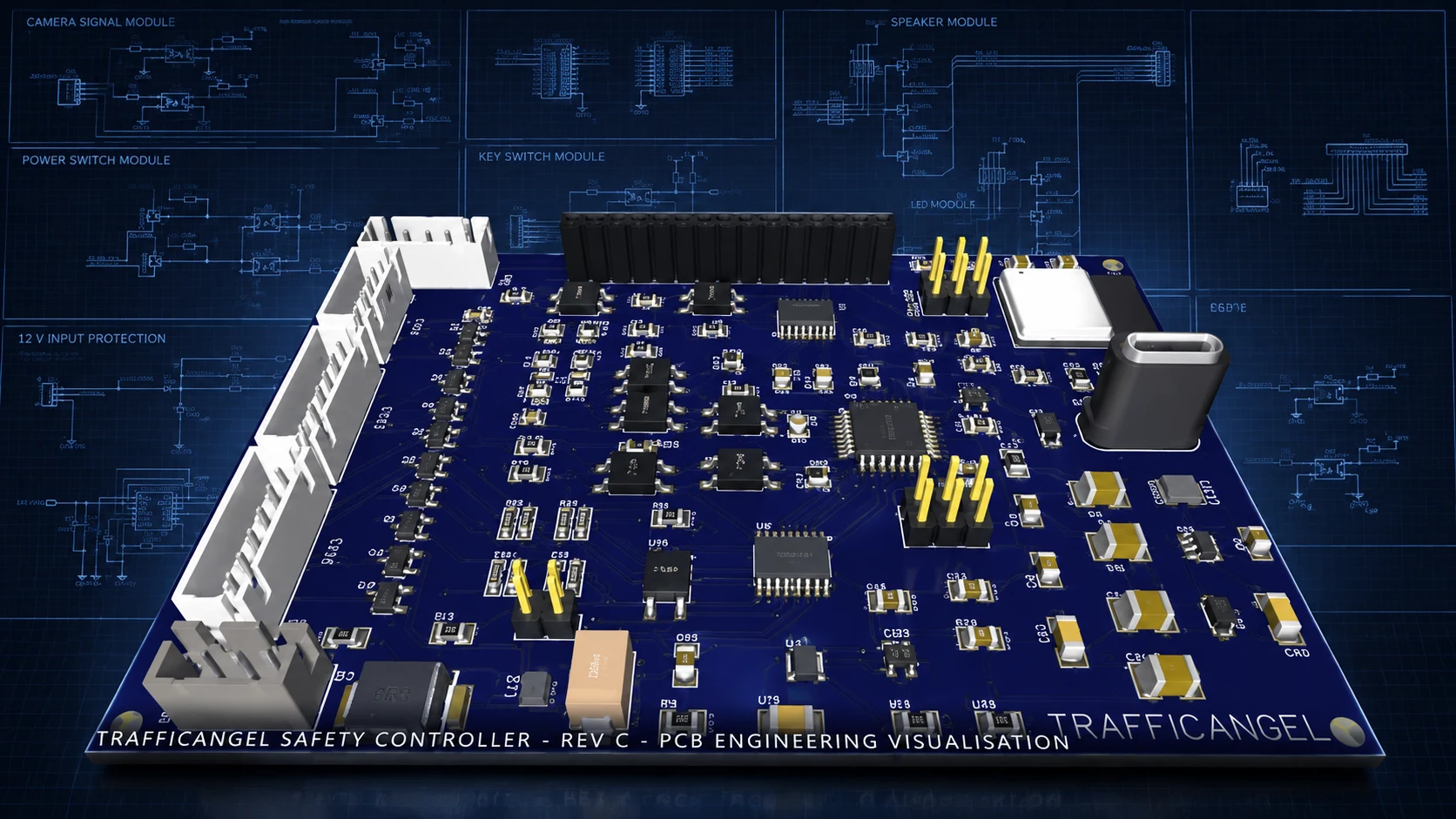
TrafficAngel Safety Controller Rev C PCB 3D engineering visualisation
TRAFFICANGEL SAFETY CONTROLLER · REV C · PCB ENGINEERING VISUALISATION
01 · Safety Controller

Independent operation.

The TrafficAngel Safety Controller is a dedicated embedded control system designed to operate independently once configured.

No PC required Normal system operation is fully autonomous.
No diagnostic panel required The diagnostic environment is a separate engineering tool.
No external application required The controller executes its embedded control logic locally.
02 · System Architecture

Modular by design.

The controller architecture separates the core embedded controller from expansion, diagnostic and production systems.

Safety Controller Core autonomous embedded control system.
Safety I/O Adapter Independent intelligent expansion module.
Diagnostic Platform Electronic Designer configuration and engineering environment.
Production Test System Dedicated manufacturing validation platform.
03 · Engineering Platform

Diagnostic & Configuration.

Electronic Designer developed a dedicated diagnostic and configuration environment to support development, commissioning, testing and system configuration.

This engineering platform is separate from the embedded controller and is not required for normal stand-alone operation.
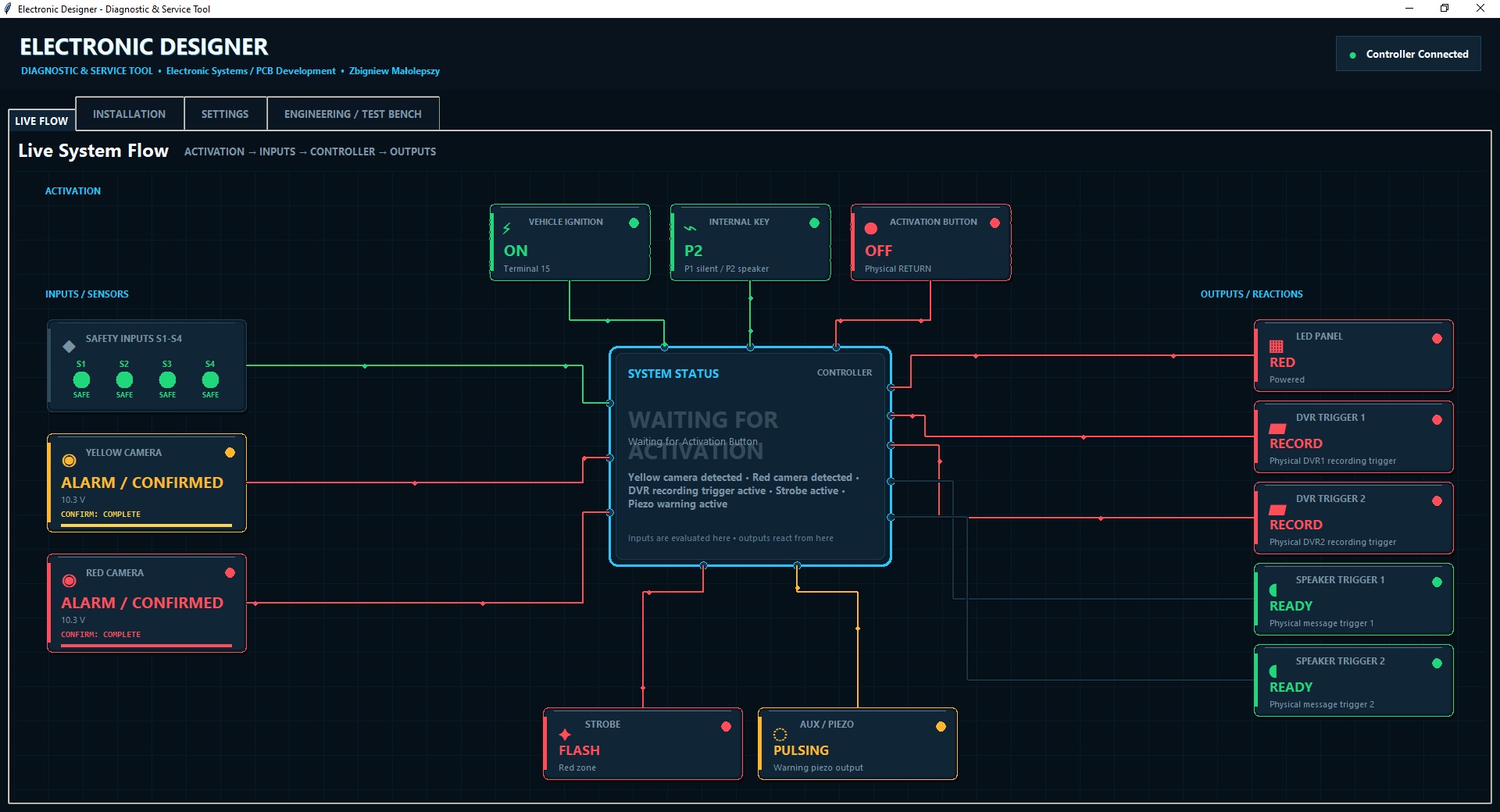
Electronic Designer Diagnostic and Service Tool connected to the TrafficAngel controller
ELECTRONIC DESIGNER · DIAGNOSTIC & SERVICE TOOL · LIVE SYSTEM FLOW
04 · Series Production

Prototype to controlled production.

Moving from engineering prototypes to volume production introduces a separate production-validation phase including controlled manufacturing data, programming, functional testing and quality control.

Controlled Build Defined production files, BOM and manufacturing configuration.
Programming Controlled firmware deployment during production.
Functional Test Automated verification of hardware, communications and I/O.
Traceability Production result, firmware version and unit identification.
Production Test System
Concept
05 · Production Engineering

Dedicated production testing.

For meaningful production volumes, Electronic Designer can develop a dedicated hardware and software test environment for repeatable end-of-line validation.

Manufacturing Test Station Dedicated hardware fixture and PC-based test software installed at the production facility.
Reference Test Station A second controlled station retained by Electronic Designer for engineering verification, service and production-reference testing.
Automated Functional Verification Power-up, controller identification, firmware verification, communications, input stimulation and physical output response can be tested automatically.
Programming & Configuration Controlled firmware deployment and production configuration form part of the manufacturing sequence.
PASS / FAIL Validation Each controller receives a repeatable test result based on measured hardware behaviour rather than visual inspection alone.
Traceability Unit identification, firmware version, test result and production data can be recorded for each manufactured controller.

The production test system is a dedicated engineering project in its own right, developed when production volume justifies automated manufacturing validation.

06 · Compliance

From engineered platform to certified product.

Moving from an engineered controller to a certified serial product is a defined engineering process. The final product configuration, installation environment, intended markets and manufacturing strategy are established first. From this baseline, the applicable compliance and type-approval route can be determined.

01 · Product Definition Final controller configuration, expansion architecture, installation environment and intended markets are defined.
02 · Design Freeze A controlled hardware and firmware baseline is established for production validation and formal testing.
03 · Production Validation Manufacturing controls, programming, functional testing, traceability and repeatable PASS / FAIL verification are established.
04 · Compliance & Type Approval Applicable automotive EMC, type-approval and market conformity requirements are assessed against the defined product.

Formal testing may identify engineering changes before the production configuration is approved. Certification forms part of a controlled product-development process rather than replacing the engineering required to create the product.

07 · Production Planning

Defining the next phase.

Expected production batch quantity? This determines the appropriate manufacturing strategy.
Expected annual production volume? This determines the appropriate level of production automation.
Which final system configuration is intended for certification? Controller, expansion architecture and final installation scope should be defined.
Which markets will the product be supplied to? Compliance requirements depend on the intended market and product classification.
What level of production validation is required? Production volume determines whether manual verification or a dedicated automated test system is appropriate.